What Kind of Thread to Use for Leather
Recently a Reddit user asked what is the best thread to use for fine work. Many people wrote in to say that our thread was at the top of their listing.
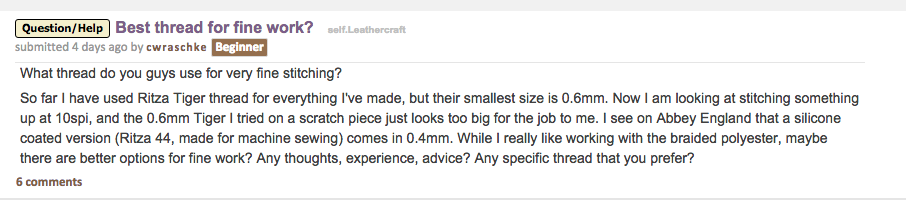
If y'all're looking to improve your work, here are some thread- related tips to help:
Stitching consistency is the nigh of import matter
No affair what thread yous cull, sewing consistently uniform stitches will make your piece of work await 'finer.' The thread tin be cute, but if the stitches are all over the identify that will be the first thing people detect. I did a post a while back on saddle stitching and every person had an almost mechanical replication of their sewing movements. They didn't squirm to see if their awl was going in correctly or peeking back and along from one side to the other. Consistency of motion will transfer to your stitching.
The dorsum side of the stitch is a gotcha for most beginners. One of my teachers described it as the 'beginner's mountain range', because the haphazard stitch pattern looked like a panorama of the Alps. As y'all become better, your awl will go into the sew together marking exactly perpendicular to the surface. When sewing, yous can isolate both axes where rotation happens: front to back where the stitches expect smaller or larger, and summit to bottom where the stitches go either closer to or further from the border. Front to back rotation typically happens when you flick your wrist going into the stitch. When you exercise that, the tip of the awl follows an arc path in the right to left movement. The peak lesser rotation ordinarily comes from raising or lowering your elbow.
If y'all're looking to meliorate your stitching technique, try belongings a big wooden spoon and, without thinking nearly it, make the aforementioned movement as y'all do when you apply your awl. Hold the spoon part like the flat of your awl. The longer handle will exaggerate the movement and yous'll be able to meet where you tend to drift.
Match stitching to the thickness of thread
Past the numbers, here are the thicknesses of our thread:
332 – 0.77mm thread bore
432 – 0.63mm thread diameter
532 – 0.57mm thread diameter
632 – 0.51mm thread diameter
832 – 0.43mm thread bore
We have a nautical chart that shows our different thread thicknesses in the aforementioned 9tpi stitch count. 0.1mm doesn't seem like a lot, but you can see the difference in thickness, especially side past side.
I recommend 532 or 632 thread at 9tpi if you're going to apply simply one size of pricking iron and thread. The 9tpi is an all-around good size for both numberless and accessories. This is what I utilize the bulk of the fourth dimension and information technology works great for finer work.
If you're going to 7tpi, I recommend the thicker 332. The smaller threads don't look bully at low run up counts and won't concur the seam equally long. The 332 looks good for larger work like handbags and duffels. Again, you lot can use 9tpi and 632 for larger work, but some styles match better with the thicker wait.
If you're going to employ 6tpi or larger, I'd actually recommend a different line of thread that has thicker sizes. I don't see the larger sizes used much in luxury/fine work, though they are oftentimes used in more than rugged styles.
If you're doing very fine piece of work like lookout straps, I'd recommend 832 at ten or xi tpi. This gives a more delicate experience to the work and the thread looks more appropriate to the size of the project.
Recently I did a tear-down of a luxury bag and saw that there were 2 thread thicknesses being used on unlike parts. They used the equivalent of 332 for the straps and handles at 7tpi, and 632 at ix tpi for the rest. The size difference seemed to be more for aesthetics since both would concur up every bit well.
Small-scale details brand finer work
Making finer work is all about the details. There are often many small differences that split the very best work from its competitors. Our thread is re-twisted to go far a little bit denser than others. Y'all would call up that the divergence would be minor but, as others have confirmed, information technology really makes the thread stand out.
Similarly, you lot can exercise a number of things to brand the thread-related details of your work better. Below are a few that you can try individually or all together.
Contrasting sew together. Use a lighter color thread on a darker leather or vice versa to really highlight your stitching work. It is also a way of challenging yourself to improve your sewing because information technology will really stand out.
Match color to lining or edging. If yous match the exterior thread to the interior of the purse, it can actually make the colors "pop" when the bag is opened. A skillful example of this technique is to use ruby thread on the outside of a greyness bag to highlight a red interior.
Minimize the hole size. If yous're using a drill or lace marker, marking your stitches using a tool to make smaller holes like a pricking iron or pricking bike. Minimizing the hole structurally makes the stitches stronger and gives it a nicer await.
Stitch instead of riveting. Using rivets is a big fourth dimension saver for creating belts or straps, but sewing them can create a effectively expect. Though it takes more fourth dimension to sew a strap closed than information technology does to rivet information technology, the results are worth it.
brookerwisequed53.blogspot.com
Source: https://www.fineleatherworking.com/blog/how-to-chose-the-best-thread-for-finer-leather-work/
0 Response to "What Kind of Thread to Use for Leather"
Post a Comment